



Quick Summary:
Starting a food truck in New Zealand takes about three to six months & somewhere between $40,000 & $120,000.
Here is the short version:
- Register your business, get an NZBN & sign up for GST if you expect to turn over more than $60,000 a year
- Register under the Food Act 2014. Most trucks cooking meat or dairy need a Food Control Plan. Coffee carts usually sit under a National Programme
- Book a recognised verifier before you apply, because your application needs their letter. Every food business gets checked within six weeks of opening
- Get a mobile trading licence from every council district you want to trade in
- Fit the truck out properly: handwashing sink, potable water, wastewater tank, refrigeration, hot holding, Electrical Warrant of Fitness, gas safety certificate if you run LPG, plus a current WOF or COF
- Sort payments & ordering before day one, not after your first bad Saturday
Why Food Trucks Are Working In NZ Right Now
A fixed site means a lease, a bond, a fit out & a landlord. A truck means none of that. You can get trading for a fraction of what a small cafe costs, & if a location does not work, you drive somewhere else. That flexibility is the whole point.
The demand side has grown up too. Markets, festivals, sports grounds, breweries & office parks all want food on site without building a kitchen. Breweries especially. A lot of them have no kitchen at all & rely completely on trucks rotating through.
Now the honest part. It is long hours. You prep, you drive, you serve, you clean, you do the books, & then you do it again. Weather sits on top of your revenue like a hand. A wet Saturday can wipe out your best day of the week & there is nothing you can do about it. Go in knowing that.
Step 1: Lock Your Concept & Prove Someone Wants It
The most common mistake is a menu that is too big. You have a bench, maybe two metres of it, & a fryer. One thing done properly beats eight things done alright.
Before you spend a dollar, do this:
Look at what your suburbs already have. Drive around at lunchtime. Check the market lineups. If there are four burger trucks working your area, that is not a gap, that is a fight.
Talk to the people who book trucks. Three event organisers & two brewery owners. Ask them what they struggle to fill. They will tell you, because they want it solved.
Do the rough maths. Average spend per customer, times realistic customers per service, times trading days per week. Be pessimistic. If the number only works when everything goes right, it does not work.
"The operators who last are the ones who got boring early. They picked one thing, priced it properly & stopped changing the menu. The ones who struggle are usually still tweaking the offer in year two."Hospitality business advisor, Auckland
Step 2: The Numbers Before The Food Truck
Here is a realistic picture of what you will spend getting to your first trading day.
| Item | Budget range (NZD) |
| Used trailer or van with basic fit out | $30,000 to $50,000 |
| Fully built new truck | $80,000 to $120,000+ |
| Commercial kitchen fit out on its own | $15,000 to $40,000 |
| Council registration & licensing | varies by council |
| Verification fees | verifier sets their own fee, get quotes |
| Insurance | annual, get three quotes |
| Branding & vehicle wrap | $2,000 to $6,000 |
| Opening stock | $1,500 to $4,000 |
| Working capital buffer | three months of running costs |
Two notes on that table.
Council fees & verification fees are not fixed nationally. Verifiers & councils set their own pricing, so ring around & get quotes instead of trusting a number you read online.
The working capital buffer is the line people delete when money gets tight. Do not delete it. Your first winter will be slower than you think, & the difference between a business that survives it & one that does not is usually just cash in the account.
Step 3: Set The Business Up Properly
This part is paperwork & it takes an afternoon. Work through it:
- Pick a structure. Sole trader, partnership or company. Sole trader is simplest. A company gives you separation if things go wrong
- Get an NZBN through business.govt.nz
- Get an IRD number for the business & register for GST if you expect turnover above $60,000
- Open a separate bank account. Do not run a food business through your personal account. You will regret it at tax time
- Sort insurance: public liability, vehicle, product liability & contents. Events will ask to see it
- Health & Safety at Work Act 2015 obligations kick in the moment you hire anybody
- If you are going in with somebody, a mate, a sibling, a partner, write down who owns the truck, the brand, the recipes & the social accounts. Do it now while everybody likes each other
Step 4: Food Act 2014 Registration
This is where most people lose weeks. Do it in this order.
Food Control Plan or National Programme?
Which one you need depends on what you sell & how you make it. Trucks preparing higher risk food like cooked meat & dairy generally need a Food Control Plan, usually the template version from MPI. Coffee carts & lower risk operations usually sit under a National Programme.
Do not guess. MPI has a tool called My Food Rules that tells you which one applies to your setup.
Who You Register With
Either your local council or MPI, depending on which plan type you land on & where you operate. Template Food Control Plans usually go through the council. Custom plans go to MPI.
What The Application Needs
Get all of this together before you apply, because a missing document stretches your processing time out:
- A site plan showing the physical design & layout of the truck
- A scope of operations, which is basically a description of what you cook & how
- The correct registration form, single site or multi site
- The name of the verification agency you have engaged
Verification
Here is the part nobody warns you about. If you are going on a National Programme or a custom Food Control Plan, you need to contact a verifier before you register & include their letter with your application.
Then once you open, a recognised verifier has to check your business within six weeks. Not a suggestion. A requirement.
The Good News
Your Food Act registration works nationally. Register once, & you are covered to sell food anywhere in New Zealand. That is one less thing to redo when you start travelling to events.
"Almost every delayed application I see is missing the same thing, which is a verifier. People assume verification happens after you open. It has to be lined up before the paperwork goes in. Sort that first & the rest moves quickly."Environmental health officer, South Island council
Step 5: Council Trading Licences & Where You Can Park
Food Act registration lets you sell food. It does not tell you where you are allowed to park & trade. That is a separate thing, & it is local.
- You need a mobile trading licence from the council for any public space you want to trade in
- You need one from every council district you plan to work in. Trading across three districts means three licences
- Selling from a park or reserve usually needs its own separate approval on top
- Requirements genuinely differ council to council. What flies in one district will not automatically fly in the next one over
Private land is different. Breweries, office parks & industrial estates sit outside council trading rules, so you only need the landowner on board. This is why so many trucks build their week around brewery rotations.
Events & markets set their own rules. Organisers will ask for proof of your registration, your verification, your insurance & your health & safety documents. Every time.
Practical tip: keep one folder, digital & physical, with every certificate in it. When an organiser rings on a Thursday because somebody pulled out of Saturday, you want to say yes in five minutes, not spend two days hunting for a PDF.
Step 6: Build or Buy The Food Truck
Used or New?
Used is faster & cheaper. You can get on the road for $30,000 to $50,000. The catch is you inherit somebody elses decisions, & sometimes somebody elses compliance problems. Get it inspected properly.
New build costs $80,000 upward but gets designed around your menu. If your food needs a specific line setup, this pays for itself in service speed.
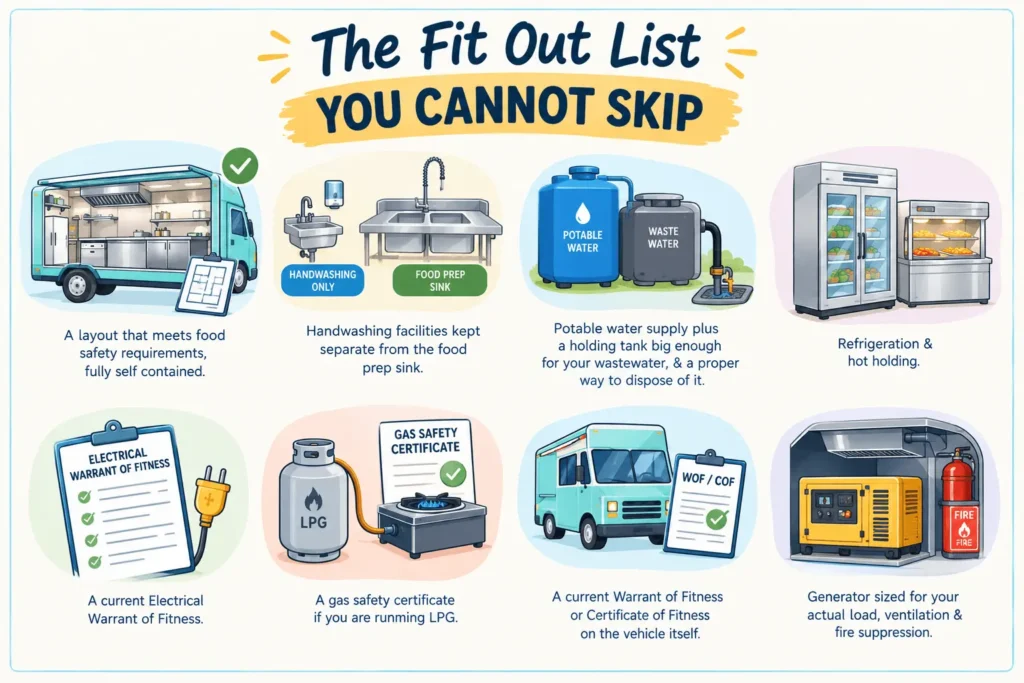
The Fit Out List You Cannot Skip
- A layout that meets food safety requirements, fully self contained
- Handwashing facilities kept separate from the food prep sink
- Potable water supply plus a holding tank big enough for your wastewater, & a proper way to dispose of it
- Refrigeration & hot holding
- A current Electrical Warrant of Fitness
- A gas safety certificate if you are running LPG
- A current Warrant of Fitness or Certificate of Fitness on the vehicle itself
- Generator sized for your actual load, ventilation & fire suppression
Design tip: map your busiest single order from the moment somebody says it to the moment it leaves the window. Lay the bench out around that path. Most people lay out around the equipment catalogue instead, & then spend two years doing an awkward shuffle every service.
Step 7: The Systems That Make Service Survivable
You can cook. That was never the question. The question is whether you can cook while forty people are waiting & somebody is asking about gluten.
Payments. Contactless is the default now. Cash only costs you real sales, especially at events & especially with younger customers.
Your till. A generic card reader takes money. It does not handle modifiers, split items, or tell you what sold. A proper restaurant POS system built for hospitality handles the messy stuff, which on a truck is most of the stuff.
Killing the queue. A QR code ordering system at the window lets people order from where they are standing instead of shuffling forward one at a time. Fewer mistakes too, because they typed it themselves & nobody misheard anything over a generator.
Pre orders for event days. If people can order ahead, food is ready when they arrive & you smooth out the rush instead of drowning in it.
Reporting. End of day numbers & stock counts tell you your margin per dish. Takings alone tell you almost nothing.
Step 8: Menu, Suppliers & Pricing
Six to eight items, maximum. Everything should share prep where it can, so one morning of work feeds the whole menu.
Cost every single dish properly. Target a food cost somewhere around 28 to 33 percent. If you cannot hit that, the dish either needs a price change or needs to come off.
On suppliers, a truck orders small, which means minimum order sizes will bite you. Build relationships with two or three suppliers who will work with your volume, & keep a backup for the week somebody lets you down.
Waste is the quiet killer. You cannot predict the weather, so build a menu where the base ingredients carry over to the next trading day instead of going in the bin.
Step 9: Get People To The Window
- Instagram & Facebook are your location board. Post where you are parked, every single trading day, without fail. That is the job
- Google Business Profile with your location kept current
- Build an event calendar. Markets, festivals, sports grounds, brewery rotations. Book them out months ahead
- Look after regulars. The truck version of loyalty is remembering the order, & it works
- Local partnerships. A standing Friday slot at one brewery is worth more than five one off events
Step 10: Running It Once You Are Live
Build a real week. Prep days, service days & one admin day. If you do not schedule the admin, it eats your weekends.
Staffing. Two or three people in a space the size of a hallway. Decide before service who calls the shots at the window, because in the middle of a rush is not the time to work it out.
Cash flow. Some event fees get paid upfront. Winter is slower. Both of those need planning for in November, not in June.
Records from day one. Your verifier will want to see them. Keeping them properly from the start takes minutes a day. Reconstructing them the week before a visit takes a weekend you do not have.
Maintenance schedule. A fridge that dies on a Friday night costs you a Saturday. Service things before they break.
Second truck? Most people should not. A second truck is a second set of everything, including staff you have to trust to do it your way when you are not there. Get one truck genuinely profitable first.

Five Mistakes That Cost NZ Food Truck Owners Money
- Buying the truck before checking where they can legally park it. Licences first, metal second
- No verifier booked, so registration stalls for weeks while the truck sits there costing money
- A menu too big for the bench, which slows service & wastes stock
- No working capital buffer for the first slow winter
- Cash only, or a payment setup that falls over at the exact moment you are busiest
Realistic Timeline
| Stage | When |
| Concept & research | Weeks 1 to 4 |
| Business setup, NZBN, GST, insurance | Weeks 3 to 5 |
| Truck sourcing & fit out | Weeks 4 to 16 |
| Food Act registration & verifier booking | Weeks 6 to 12 |
| Council trading licences | Weeks 8 to 14 |
| Soft launch | Weeks 14 to 20 |
Three to six months is normal. Faster than that usually means something got skipped.
FAQs
- How much does it cost to start a food truck in NZ?
Roughly $40,000 to $120,000 depending on whether you buy used or build new. A basic used trailer can get you trading for around $30,000 to $50,000. - Do I need a Food Control Plan or a National Programme?
Trucks cooking higher risk food like meat & dairy generally need a Food Control Plan, while coffee carts & lower risk setups usually sit under a National Programme. Use the My Food Rules tool on the MPI site to confirm. - Do I need a licence for every council I trade in?
Yes. Food Act registration is national, but mobile trading licences are issued district by district. - Can I run a food truck from home?
You can base & store it at home, but you still need Food Act registration & you must check your local council planning rules before prepping there. - How long does it take to get a food truck trading?
Three to six months from concept to first service for most people. Registration & verification are usually the slowest parts. - Is a food truck profitable in New Zealand?
It can be, with a tight menu, controlled food costs & a steady event or brewery calendar. Profit usually comes from consistent bookings rather than big one off days.